How to Manage Thrips in Glasshouse Crops
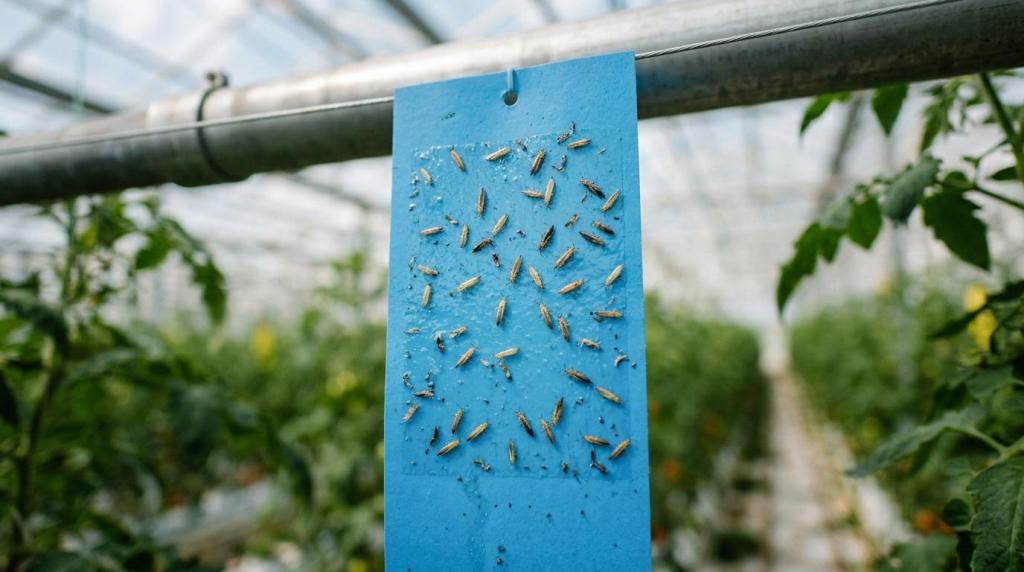
Thrips are small, quick to spread, and far more serious than their size suggests. In glasshouse crops they scar leaves, mark flowers and fruit, suppress market quality, and, in the worst cases, open the door to virus problems that are much harder to contain than the insects themselves.
That is why good thrips control is rarely about one treatment. The strongest results usually come from a disciplined IPM programme built on exclusion, regular monitoring, and timely intervention. Official extension guidance has repeated this message for years, and it still holds true across vegetables, ornamentals, herbs, and nursery production under glass.
Why thrips control in glasshouse crops is difficult
A thrips outbreak can look modest at first. A few adults appear on sticky cards, light feeding shows on petals or young leaves, and the crop still seems saleable. Then numbers rise quickly. Western flower thrips, Frankliniella occidentalis, is especially troublesome because it reproduces well in protected cropping and is also linked with virus transmission, including TSWV and INSV.
The biology of thrips explains why control so often feels patchy. Eggs are inserted into plant tissue, where sprays cannot reach them easily. Larvae feed on the crop, while pupal stages may be hidden in growing media, debris, or protected plant parts. Adults are mobile and can move between hosts fast, especially where weeds, incoming plant material, and open vents give them an easy route.
This means a control tactic that looks strong on day one may miss a large part of the population.
| Thrips stage or location | Why it matters in glasshouse crops | Best management focus |
|---|---|---|
| Eggs inside plant tissue | Hard to hit with contact products | Repeat timing, prevention, monitoring |
| Feeding larvae on leaves and flowers | Direct crop damage and virus risk | Early detection, biocontrol, targeted sprays |
| Pupae in media or sheltered areas | Often escape foliar treatment | Hygiene, media awareness, repeated interventions |
| Mobile adults | Spread quickly through the house | Sticky cards, mass trapping, exclusion, rotation of controls |
A successful programme accepts that no single tool reaches every stage equally well. That is the reason integrated management is not just good practice, but the practical starting point.
Thrips exclusion and prevention at glasshouse entry points
The cheapest thrips are the ones that never enter the glasshouse. University and extension guidance is very consistent on this point. Screening ridge vents, side vents, louvre vents, and cooling-pad walls can reduce entry pressure, especially at times of high outside activity. If a house already has airflow infrastructure in place, the question is often not whether screening helps, but whether mesh choice and maintenance are good enough for the pressure the site faces.
Exclusion also depends on what surrounds the crop. Weeds inside and outside protected structures can harbour thrips and act as a bridge into the house. Incoming young plants, plug trays, and ornamentals from mixed sources are another common route. A site can have good chemistry, good beneficials, and still struggle if plant arrivals are not checked carefully.
A strong prevention routine usually includes:
- screened vents and openings
- weed removal inside and around the structure
- quarantine checks on incoming stock
- prompt removal of crop debris
- clean propagation areas
These are not glamorous measures, but they often decide whether the season starts with low background pressure or a hidden infestation.
Thrips monitoring with sticky cards and crop scouting
If prevention lowers the odds, monitoring tells you what is actually happening. Cornell guidance highlights weekly counts of adult thrips on yellow or blue sticky cards to track population trends and judge whether a programme is working. That point matters. Presence alone is not enough. Good treatment decisions rely on counts, trends, and location.
Sticky cards should be distributed in a way that reflects crop layout, entry points, and known risk zones. Side vents, doors, propagation areas, and warmer sections often deserve extra attention. Blue and yellow cards are both used in protected cropping systems, and local preference often depends on crop, background pest pressure, and what the team can read consistently week by week.
Scouting on the plant remains just as important. Adults and larvae can be found in flowers, growing points, folded leaves, and other sheltered sites. Tapping flowers over a pale surface is still a useful practical method, especially where flower crops or fruiting vegetables are involved.
The records worth keeping are straightforward:
- Trap counts: adults per card per week, recorded by house and location
- Crop checks: larvae, adults, feeding scars, distorted growth, flower damage
- Hotspots: vents, doors, propagation bays, dry or stressed areas
- Programme notes: beneficial releases, sprays, trap changes, sanitation work
This kind of record turns control from guesswork into management. It also helps separate a true outbreak from a short-term flush after weather changes or crop movement.
Cornell also notes that mass trapping with large yellow sticky cards or hopper tape near side vents can help catch thrips dispersing into the house. Used well, that creates a useful buffer at likely entry points.
Biological thrips control in planned IPM programmes
Biological control can work well against thrips in glasshouse systems, though results depend heavily on timing, consistency, crop type, and the wider programme around it. In vegetable production under protection, beneficials are often part of the standard plan rather than an emergency add-on. Ornamentals can also benefit, though tolerance for feeding damage is often lower, which makes early action even more important.
The key word is planned. University guidance is clear that biological control should sit inside a structured IPM programme, not act as a rescue treatment after populations have already run ahead. Beneficial insects and mites need a manageable pest level, a suitable climate, and enough continuity to establish pressure on the pest.
Virus risk changes the picture. Guidance from UMass Amherst warns that biological control should not be relied on when TSWV or INSV is already present in the greenhouse. At that point, the priority becomes rapid suppression and crop protection, because even low numbers of virus-carrying thrips may create serious losses.
A balanced biological programme often depends on three linked conditions:
- Early release timing: start before thrips numbers rise sharply
- Supportive crop conditions: suitable humidity, temperature, and spray compatibility
- Stable monitoring: regular scouting to check establishment and adjust the plan
Where biologicals are used, spray choice becomes more sensitive. Broad-spectrum chemistry can remove beneficial populations just when they are needed most.
Insecticide timing for thrips outbreaks under glass
Chemical control still has a place in glasshouse thrips management, especially where numbers are climbing fast, crop value is high, or virus risk is unacceptable. The problem is that poorly timed sprays often disappoint. Thrips biology again is the reason. Eggs are protected in plant tissue, pupae can be hidden away, and reinvasion may continue from outside or from nearby hotspots.
UMass guidance gives a useful principle for timing. When sprays are needed, applications are often made two or three times, five days apart at 70 to 85°F, with shorter intervals at higher temperatures and longer intervals at lower temperatures. The aim is to catch newly emerged and newly active stages as they appear, rather than treating once and assuming the job is done.
Resistance management matters just as much as timing. Thrips populations have a long history of developing resistance where the same mode of action is used too often. Rotating approved products, maintaining coverage quality, and avoiding unnecessary use all help protect efficacy.
When a spray programme is required, keep these points in mind:
- Base the decision on counts: rising numbers and crop damage, not simple presence
- Time repeat applications carefully: intervals should match temperature and thrips development
- Target coverage: flowers, undersides of leaves, growing points, and hotspots
- Protect IPM compatibility: choose products that fit with beneficials where possible
This is where a good monitoring record earns its keep. It shows whether the spray interrupted population growth or whether pressure is returning through entry points and untreated reservoirs.
Mass trapping and kairomone lures in thrips IPM
Mass trapping has moved well beyond being just a monitoring extra. In high-pressure periods, especially near vents and likely ingress points, a stronger trap network can remove meaningful numbers of adults and reduce local damage pressure. It will not replace sanitation, scouting, or timely treatment, though it can strengthen the whole system.
As Foderven’s guidance on disinfection in poultry housing notes, routine cleaning and targeted disinfectants close down pest and pathogen reservoirs between cycles—logic that applies just as well to benches, floors and guttering in protected crops.
Semiochemical tools are attracting more interest here. Crop IQ Technology describes IQ Thrips-X as a species-specific kairomone dispenser designed for use with sticky traps. According to the product page, it can reduce damage by around 8% to 50% compared with conventional systems, is compatible with established IPM tools, and does not harm beneficial insects. Those are product claims rather than independent extension recommendations, yet the fit with an IPM approach is clear: attract the target pest to traps while keeping biological control options open.
That species focus is useful where growers want a more directed trapping strategy rather than simply increasing card numbers.
In practical terms, lure-based trapping makes the most sense when it is treated as one layer within the programme:
- near vents and doors
- in known hotspots
- alongside weekly count records
- with trap replacement kept on schedule
For growers aiming to reduce reliance on repeated chemistry, tools like this can add a helpful edge, especially when pressure is identified early.
A weekly routine for glasshouse thrips management
The best thrips programmes are rarely complicated. They are regular. A site that looks at the crop once a week in a structured way will usually outperform a site that reacts only after visible damage appears.
A practical weekly routine might look like this:
- Check sticky cards by house, row, and vent line.
- Record counts rather than writing “present”.
- Inspect flowers and growing points in hotspot zones.
- Remove weeds and crop debris immediately.
- Decide whether the trend supports biological action, mass trapping changes, or a timed spray sequence.
That discipline is especially valuable in mixed production units, where one crop can silently feed pressure into another. Ornamentals, herbs, propagation material, and fruiting crops do not all show thrips damage in the same way, so a single site-wide routine helps keep standards even.
Glasshouse thrips control improves when every action is linked to the biology of the pest. Keep them out where possible. Count them properly when they arrive. Use biological, physical, and chemical tools in the right order. Then review the trend every week, because the crop always tells the truth before the invoices do.