Early-Season Protection Programmes: How to Reduce Pest Pressure Before It Peaks
When pest pressure explodes in mid-season, the damage often started much earlier. A crop that is slow to establish, uneven in vigour, or already carrying hidden feeding injury is far less able to cope when the main pest wave arrives. That is why a well-designed early-season pest management programme is not simply a defensive step. It is a way to protect yield potential, crop quality and input efficiency from the first days of establishment.
For professional growers, the real opportunity lies in acting while pest populations are still low, patchy and easier to suppress. Early intervention can reduce the need for rescue treatments later, support beneficial organisms, and give agronomy teams better control over timing, spend and field operations.
Why early-season pest management programmes matter
Young crops are vulnerable because they have limited leaf area, shallow roots and little room for recovery. A small amount of feeding on a seedling can have a far greater effect than the same level of feeding on a mature plant. Thrips in cotton, wireworms in maize, flea beetles in brassicas, aphids in vegetable crops, and early moth flights in orchards are all examples of pests that can shape the season long before peak pressure is visible.
The principle is simple: lower the starting population, protect the most vulnerable crop stage, and stop minor infestations from becoming expensive outbreaks.
Research across field crops, vegetables and fruit systems repeatedly shows the same pattern. When early-season pressure is managed well, crops establish more evenly, canopy development is stronger, and later control decisions become more selective. Late sprays may still be needed in some situations, but they are often fewer, better timed and more effective.
Timing is not a detail. It is the programme.
Early risk is often highest where fields already favour pest survival or crop emergence is slow:
- cool soils and delayed establishment
- high residues on the surface
- nearby volunteer hosts
- previous grass or cereal history
- mild winters that support carry-over populations
Early-season pest risks by crop and production system
Not every crop faces the same threats, and not every field needs the same level of protection. A risk-led approach is always better than a blanket one. That matters economically, and it matters for resistance management and sustainability.
The table below sets out common early-season patterns across key cropping systems.
| Crop or setting | Common early-season pests | Practical early actions |
|---|---|---|
| Cotton | Thrips, aphids, whiteflies, wireworms, early plant bugs | Seed or in-furrow protection, trap-based monitoring, fast follow-up scouting, attention to stand vigour |
| Maize | Wireworms, seedcorn maggot, cutworms, stink bugs | Field history review, seed protection where justified, residue management, early plant inspection |
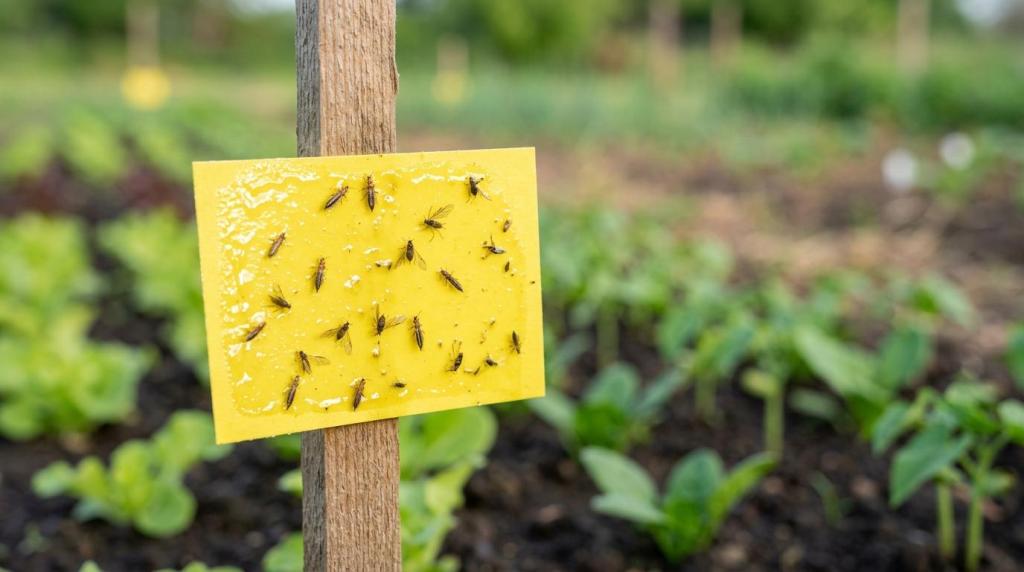
| Brassicas and vegetables | Flea beetles, thrips, aphids, leafminers, cutworms | Sticky traps, crop hygiene, targeted biologicals, covers where suitable, rapid threshold checks |
| Onions and alliums | Onion thrips, aphids | Early monitoring, crop hygiene, focused intervention before populations spread across blocks |
| Orchards and vineyards | Fruit flies, codling moth, oriental fruit moth, stink bugs, mites | Pheromone trapping, mating disruption, sanitation, early attract-and-kill or mass trapping |
| Broadacre pulses and cereals | Aphids, slugs, wireworms, armyworms in some regions | Risk mapping, seedbed preparation, local thresholds, regular field walking from emergence |
A strong programme starts with the pest complex that is most likely, not simply the one that caused trouble last year. Weather, planting date, residue levels and nearby host crops can all change the picture.
Building an early-season pest management programme
An effective programme is layered. It does not rely on one product, one chemistry, or one field visit. It combines prevention, detection and targeted action in a way that matches crop stage and local pest pressure.
A practical programme usually includes four connected parts:
- Risk mapping: field history, neighbouring hosts, previous crop, soil condition and likely spring weather
- At-plant protection: seed, in-furrow, transplant-stage or perimeter measures chosen for the expected pest mix
- Early monitoring: traps, sticky cards, walking, plant counts and root inspection from emergence onward
- Threshold-led action: intervention only when crop stage, pest density and damage risk justify it
Pre-plant and planting decisions for early pest suppression
The programme often begins before the planter enters the field. Rotation, residue management, sanitation and planting date can change the level of pressure a crop faces in the first few weeks. Fields coming out of grass, with a history of wireworm, demand a different plan from clean land with low background risk. Brassicas planted into conditions that favour flea beetle movement need a different strategy from those going into rapid growth conditions.
Plant vigour is also part of pest management. Crops that emerge quickly and evenly can grow away from low to moderate feeding pressure far better than weak stands. Good seedbed conditions, strong nutrition, balanced plant health inputs and careful irrigation planning are not separate from pest control. They help determine how much injury a crop can tolerate.
Monitoring and threshold-based action in the first weeks
Once the crop is in the ground, attention has to shift from prediction to evidence. That means trap placement, field checks and clear recording routines from day one. Semiochemical traps, sticky cards and visual scouting all help, but they are strongest when used together.
Pheromone and attractant tools are especially useful because they detect pest presence before visible crop injury becomes widespread. In fruit systems, that can mean catching the first significant flights before fruit is vulnerable. In protected crops and vegetables, it can mean spotting rising thrips or leafminer activity while numbers are still manageable.
A simple early-season routine can keep the programme disciplined:
- Check traps and monitoring points on a fixed schedule.
- Inspect representative plants across hot spots and lower-risk areas.
- Record counts, crop stage and visible feeding, not just presence or absence.
- Compare findings against local thresholds or agreed action triggers.
- Act quickly where needed, then re-check results within a defined interval.
Biological and behaviour-based tools in early-season pest management
The strongest modern programmes do not depend only on conventional insecticides. Behaviour-based and biological tools are giving growers more ways to reduce pest pressure early, with better selectivity and lower disruption to beneficial species.
Semiochemicals are a good example. Species-specific pheromone lures can be used for monitoring, mass trapping and, in some cases, mating disruption or attract-and-kill approaches. When these systems are deployed before pest populations build, they can reduce colonisation pressure and sharpen spray timing. That is especially valuable in orchards, vineyards, vegetable crops and high-value systems where quality standards are tight.
Repellent and push-pull approaches can also be effective at the start of the season. A repellent signal on or around the crop, combined with attractive traps or trap zones nearby, changes pest movement rather than simply reacting after feeding has begun. Used well, this can reduce pressure on the crop edge and buy valuable time during establishment.
Biological inputs add another layer. Entomopathogenic nematodes, microbial products, and plant health biostimulants can support resilience in the root zone and canopy, particularly where soil pests, stress or disease interactions make young crops more vulnerable. These tools work best as part of a planned sequence rather than a last-minute substitution.
For growers wanting a more integrated route, science-led platforms now combine semiochemical lures, sticky trapping, push-pull products, biological controls and technical guidance within one early protection strategy. That approach suits farms aiming to reduce chemical reliance without losing control over risk.
Early detection tools and data-led agronomy decisions
Monitoring is most valuable when it changes the decision, not when it merely confirms a problem that is already obvious. That is why digital agronomy and structured trap data are becoming more useful in early-season pest management programmes.
When trap counts are linked to field location, crop stage and weather trends, agronomists can see patterns that would otherwise be missed. A rise in one block but not another may suggest a border issue, nearby host pressure, or a timing difference linked to drilling date. That supports targeted action, which is better for cost control and better for stewardship.
This is where semiochemical monitoring systems can make a real difference. Species-specific lures, sticky traps and developing smart-trap technologies give earlier warning and cleaner signals than broad, reactive scouting alone. They also help preserve beneficial insects by reducing unnecessary whole-field applications.
Good data should lead to clear questions:
- Are populations rising fast enough to justify action now?
- Is the pressure localised or field-wide?
- Is the crop still in its most vulnerable stage?
- Will a biological or behaviour-based response be sufficient?
- Does the field need intervention, or just closer observation?
Why early-season control often outperforms late rescue treatments
Late rescue sprays can be necessary, but they are rarely the ideal strategy. By the time heavy feeding is visible, part of the economic damage has often already occurred. Stand loss, stunting, delayed crop development and downgraded quality are hard to reverse.
Early-season protection tends to outperform late reaction in several ways.
- Yield protection: young plants avoid the setback that limits later growth
- Input efficiency: fewer repeat sprays are often needed later
- Resistance stewardship: selective tools and better timing reduce pressure on chemistries
- Biological stability: beneficial insects are less disrupted
- Operational control: managers can plan interventions instead of chasing outbreaks
There is also a business case here. In many crops, the aim is not to eliminate every insect. It is to prevent early populations from crossing the point where later treatment becomes more frequent, more disruptive and more expensive. One well-timed early action can remove the need for several reactive passes later in the season.
That said, early protection still needs discipline. Some fields will carry low risk, and broad prophylactic treatment is not always justified. The best programmes combine local knowledge, monitoring evidence and product choice rather than defaulting to routine inputs.
A practical early-season pest routine for growers and agronomists
The first four to six weeks after planting or emergence often decide the success of the programme. Teams that treat this window as a structured campaign usually get better results than those relying on occasional scouting.
A good working model is to start with field-by-field risk ranking, install monitoring tools before or at the point of crop vulnerability, and review results on a fixed weekly schedule. Any action taken should have a clear purpose: reduce colonisation, protect the seedling, suppress the first generation, or hold pressure below threshold until the crop becomes more tolerant.
Where farms want to strengthen this approach, technical support and integrated product planning can help connect the pieces. Semiochemical lures, push-pull methods, biological controls, plant health inputs and data-led agronomy are most effective when they are planned as one early-season system rather than added separately under pressure.
That is where early-season pest management becomes more than prevention. It becomes a smarter way to build a stronger crop from the start.