Pheromone-Based Pest Control Explained: How Semiochemicals Work in UK Cropping Systems
Pheromone pest control has moved well beyond the status of a niche tool. Across UK cropping systems, it is now part of a serious discussion about precision agronomy, reduced chemical reliance and stronger integrated pest management. For growers facing tighter residue expectations, resistance pressure and closer scrutiny of environmental impact, that shift matters.
The appeal is straightforward. Pheromones can target a pest species with remarkable precision, fit neatly into monitoring-led programmes and, in the right setting, suppress populations before economic damage takes hold. When they are used well, they help growers act earlier, spray less often and make better decisions with better data.
What pheromone pest control means in crop protection
Pheromones are chemical signals released by one member of a species and detected by another member of the same species. In crop protection, the best-known example is the sex pheromone, often released by females to attract males. Scientists can identify these compounds, manufacture them and place them in dispensers, traps or formulated control systems.
Pheromones sit within the wider group of semiochemicals. Semiochemicals are natural information chemicals that influence insect behaviour. Some act within a species, like pheromones. Others act between species. That distinction matters because it explains why semiochemical technology can be both highly selective and highly adaptable.
For practical agronomy, the promise is clear:
- species-specific targeting
- low residue risk
- compatibility with biological control
- support for resistance management
- better timing of interventions
This is one reason semiochemical tools are so useful in professional systems. They do not try to do everything. They do one job very precisely, and that precision has real value in field crops, orchards, protected crops and stored product environments.
How semiochemicals work against insect pests
A pheromone product does not need to kill an insect directly to deliver control. In many cases, it changes behaviour so effectively that pest pressure falls anyway. That can happen in several ways, depending on the pest, crop and system design.
Pheromone monitoring in UK crop scouting
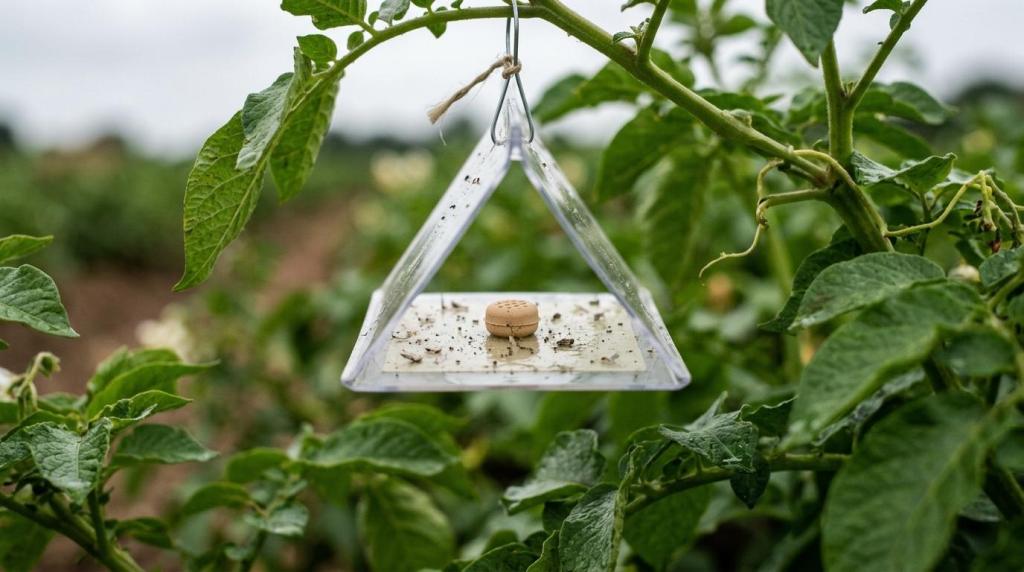
The most widely used approach is monitoring. A lure is placed inside a trap, male insects fly towards it, and trap catches show whether the pest is present, increasing or peaking. That information can be linked with crop stage, weather data and local thresholds to sharpen decision-making.
Monitoring is often where growers first see the value of pheromones. Instead of treating by calendar date or guesswork, they can see pest activity in near real time. In practice, this improves spray timing and reduces unnecessary applications.
Mating disruption for pest population suppression
Mating disruption takes the same signal and uses it at a much larger scale. Dispensers release synthetic pheromone across the crop so that males struggle to find females. If mating is reduced, egg laying falls, larval populations drop and crop damage can be held below the economic threshold.
This method tends to work best where the target pest is well defined, the treated area is large enough and the dispenser programme is maintained properly. In perennial crops and some protected systems, it can be especially effective.
Mass trapping and attract-and-kill methods
Some programmes use pheromone-baited traps in larger numbers to remove a meaningful share of the pest population. Others combine attraction with a killing agent. These approaches are more variable than monitoring or mating disruption, yet they can be very useful where pest pressure is moderate and deployment is disciplined.
The main semiochemical uses can be compared quite simply:
| Semiochemical approach | Main purpose | Best suited to | Typical benefit |
|---|---|---|---|
| Monitoring traps | Detect and time pest activity | Field crops, protected crops, orchards, stores | Better decisions and more accurate intervention timing |
| Mating disruption | Reduce successful mating | Orchards, vineyards, some protected systems, area-wide blocks | Lower pest pressure with reduced insecticide dependence |
| Mass trapping | Remove adults from the system | Localised populations, enclosed or smaller areas | Population reduction and cleaner crop scouting |
| Attract-and-kill | Draw pests to a localised toxic point | Selected pests where robust formulations exist | Targeted suppression with reduced treated area |
Why pheromone pest control suits UK cropping systems
UK growers work within a demanding mix of conditions. Weather can be unsettled, pest pressure can shift rapidly, crop values vary sharply by sector and pesticide choices are under pressure from both regulation and resistance. That creates a strong case for tools that add precision without adding unnecessary complexity.
Pheromones fit this environment well because they are information-rich. A trap catch is not just a count. It is a signal about pest movement, emergence timing and risk. That turns pest management into a more measured process.
Several features of UK agriculture make semiochemicals especially attractive:
- Residue expectations: Strong fit for crops and supply chains with strict quality demands
- Resistance pressure: Useful where repeated chemistry has narrowed future options
- Beneficial insects: Compatible with many biological and conservation-minded approaches
- Protected cropping: Well suited to enclosed environments where pest tracking must be very sharp
- Sustainability goals: Supports lower-input programmes and reduced broad-spectrum use
There is also a commercial angle. A well-run pheromone programme can improve the value of every other control decision around it. If the monitoring signal is reliable, growers can place sprays more accurately, avoid poorly timed applications and protect beneficial species that are already working in the crop.
Where pheromones fit in integrated pest management programmes
Pheromone pest control works best as part of a structured IPM programme, not as a stand-alone idea dropped into the season without context. A trap on its own is not a strategy. It becomes strategic when it is linked to scouting, thresholds, crop stage, pest history and action plans.
In practical terms, that means the agronomy team needs a few things in place before deployment begins. The target species must be confirmed, the right lure must be selected, trap placement must suit the pest’s behaviour and the results must be reviewed regularly. A good monitoring system is disciplined, not casual.
A sensible implementation plan often includes:
- Target pest selection: choose the species causing economic risk, not just the species that is easiest to trap
- Trap placement: put traps where adults are likely to enter, fly or congregate
- Inspection frequency: keep checks regular enough to catch the rise, peak and decline of activity
- Decision rules: connect trap counts to thresholds, degree-day models or local advisory data
- Programme integration: match the pheromone signal with biologicals, biostimulants, nutrition and any chemical interventions
This is where technical support makes a difference. Interpreting pheromone data can be straightforward in a stable system and more demanding in a mixed landscape. Good guidance helps growers avoid two common mistakes: reacting too early to a low catch, or reacting too late because the first clear signal was missed.
Common UK pest situations for semiochemical tools
Pheromones are not equally advanced for every crop-pest combination, though the range continues to grow. In the UK, some of the most practical uses are already established in orchard systems, protected horticulture and stored product protection. Others are used mainly for monitoring rather than direct suppression.
The right fit depends on biology. Species with a well-characterised sex pheromone and a clear adult flight period are often strong candidates. Species with highly mobile populations, overlapping generations or heavy immigration from outside the treated block may need a more layered programme.
A few common situations illustrate the point:
| Crop or environment | Pest example | Typical semiochemical use | Main objective |
|---|---|---|---|
| Apples and pears | Codling moth | Monitoring and mating disruption | Protect fruit quality and reduce insecticide inputs |
| Protected tomatoes | Tuta absoluta | Monitoring, mass trapping, integrated behavioural control | Early detection and suppression |
| Brassicas | Diamondback moth and other moth pests | Monitoring | Time scouting and treatment more accurately |
| Stored grain and food facilities | Moths and beetles | Trap-based monitoring | Detect infestations early and focus hygiene and control |
| Soft fruit and protected crops | Selected moth pests | Monitoring | Support precision IPM and reduce reactive spraying |
This list is not fixed. Semiochemical development continues to expand, and the strongest programmes often combine pheromones with biological controls, habitat management and closely timed crop protection inputs.
What growers should watch when choosing pheromone products
Not all pheromone systems are equally robust. The chemistry may be elegant, yet field performance still depends on formulation quality, dispenser longevity, release rate and technical fit with local conditions. A product that performs well in one climate or crop architecture may need adjustment elsewhere.
That is why product choice should go beyond the lure name or the active compound. Growers and distributors should ask how long the dispenser releases effectively, how stable it is in variable weather, whether the trap design is suitable for the target pest and how the data should be interpreted in-season.
A strong assessment usually covers these points:
- lure accuracy and species specificity
- dispenser lifespan
- weather stability
- ease of deployment
- quality of technical backup
Commercial practicality matters as well. Reliable supply, competitive pricing and after-sales guidance make adoption much easier, especially for larger acreages or multi-site businesses. UK-made options can also appeal where consistency, lead times and local technical service are part of the purchasing decision.
Data-driven agronomy and pheromone monitoring
One of the most promising aspects of pheromone pest control is its natural fit with data-led agronomy. Trap catches are measurable, repeatable and highly suitable for digital recording. Once those records are linked with temperature data, crop stage and historic pest pressure, decision-making becomes stronger season by season.
This is especially useful for pests with predictable development linked to heat accumulation. A trap catch can mark the start of a biofix, and degree-day models can then estimate egg hatch or larval activity. That gives growers a clearer window for intervention than a calendar spray ever could.
The best results often come when pheromone data is used alongside other information rather than in isolation. Field observations, weather forecasts, local alerts and crop growth data all help turn a simple trap catch into an actionable agronomy signal.
Where semiochemical pest control is heading in UK agriculture
The direction of travel is encouraging. Semiochemical technology is becoming more durable, easier to deploy and better integrated with wider biological and regenerative approaches. Growers are also more familiar with threshold-based management than they were a decade ago, which makes adoption easier.
There is growing interest in long-duration dispensers, biodegradable delivery systems, earlier protection strategies and combinations of behavioural control with biocontrols or plant health products. That is a useful shift because pest pressure is rarely solved by one tool alone. The strongest systems stack compatible tools in a clear order.
For UK agriculture, that means pheromone pest control is likely to become less of an add-on and more of a planning tool. Used well, it helps growers move from reactive treatment towards earlier, more exact and more sustainable pest management, with each trap catch adding a little more certainty to the season ahead.